In foodservice packaging, new materials appear constantly.
New coatings. New substrates. New claims about performance or sustainability.
Yet one material continues to dominate high volume cartons and trays across bakeries, distributors, and foodservice operations.
Recycled chipboard.
It is not a new innovation. In fact, its longevity is exactly why it continues to perform so well in real world packaging environments.
A Material Built for High Volume Packaging
Foodservice packaging must work within a fast moving supply chain.
Cartons need to run cleanly through converting equipment, ship efficiently on pallets, and perform reliably once they reach the end user.
Recycled chipboard has proven itself in these environments for decades.
The material cuts cleanly, folds consistently, and provides the structural stability needed for trays, bakery cartons, and takeout packaging without unnecessary weight.
For high volume operations, reliability matters more than novelty.
The Advantage of Recovered Fiber
Another reason recycled chipboard remains widely used is the material itself.
Chipboard is produced from recovered paper fibers that have already gone through the paper lifecycle. Instead of relying entirely on newly harvested fiber, the material utilizes paper that has already been collected, processed, and repurposed.
As awareness around packaging materials has grown, many businesses are paying closer attention to how their packaging is produced.
Recycled chipboard offers a straightforward answer. It turns existing paper resources back into usable packaging products.
Virgin Fiber Boards Tell a Different Story
Some paperboard packaging materials rely heavily on virgin fiber.
Boards such as solid bleached sulfate or coated unbleached kraft are produced primarily from newly harvested wood fiber.
These materials serve important purposes in certain applications, particularly when high brightness or specialized barrier properties are required.
However, for many foodservice packaging cartons and trays, that level of material intensity simply is not necessary.
Recycled chipboard provides the structural performance needed for many applications without requiring the same level of virgin fiber input.
Operational Simplicity Still Matters
Beyond materials, foodservice packaging businesses care about operational simplicity.
Packaging must assemble quickly, store efficiently, and integrate easily into packing lines.
Chipboard cartons fold easily, ship flat, and stack well in warehouse environments. They are familiar to packing staff and easy to implement without operational disruption.
This simplicity is one of the main reasons chipboard continues to dominate many foodservice packaging categories.
A Proven Foodservice Packaging Material
The foodservice industry ultimately values packaging that performs consistently.
Recycled chipboard has remained a core material for folding cartons and trays because it delivers a practical balance of strength, cost efficiency, and responsible material use.
For distributors, bakeries, and high volume food operations, that balance continues to make recycled chipboard the most practical choice.
Sometimes the most reliable materials are the ones that have already proven themselves over decades of real world use.
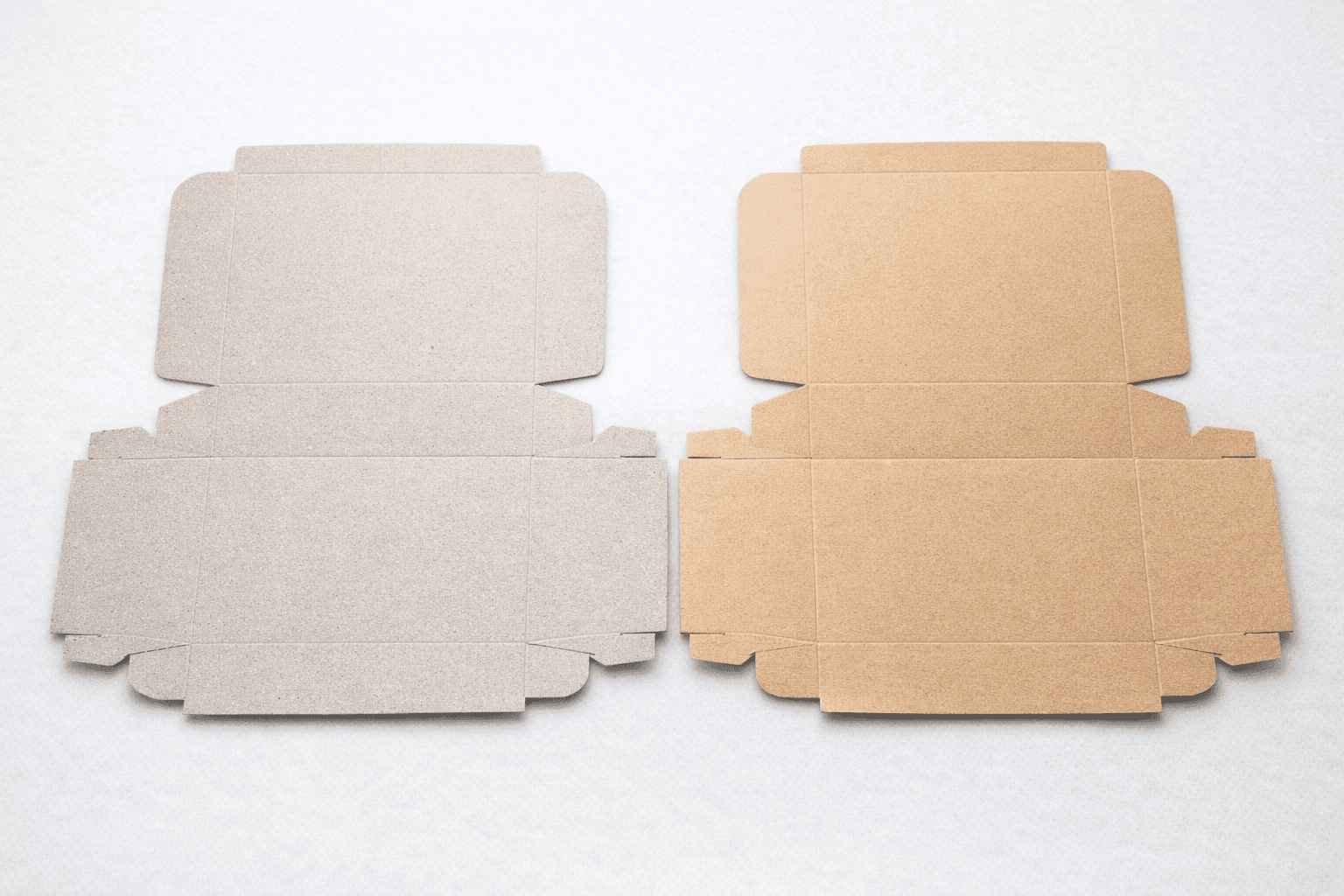
Recycled chipboard and kraft paperboard folding carton blanks side by side. Both materials are widely used in foodservice packaging.